May 24, 2026
たま
A Day Trip to Kishi Station
Travel Japan
I’m always impressed with the stories of animals that leave a legacy that surpass those of most humans. Japan’s own Hachiko is an enduring story of a dog whose loyalty captured the attention of the world for generations. He waited years for his deceased owner to return at a modest station called Shibuya. Now, Hachiko is immortalized in bronze at what would become the world’s second busiest station.
Anyways, today I went about 2-hours south of Kyoto to visit a train station in the middle of the countryside because of a cat.
The Legend of Tama
In rural Wakayama, a short train line has existed since the 1930s. In the early 2000s, ridership waned and the Nankai Electric Railway Company couldn’t sustain the line financially. It planned to close the train line, but not before the brand new Wakayama Electric Railway Company took over the line in 2006, sparing it, at least temporarily.
As part of the takeover, new roads and infrastructure had to be put in around the stations. A shelter for stray cats would need to be shutdown to make room. A plea was made to let one of the cats, Tama, live in the station. The president of the Wakayama Electric Railway Company agreed, viewing Tama as a maneki-neko1.
In 2007, Tama was appointed as the station master of Kishi Station. She would be paid in cat food and would greet passengers in a station master’s uniform. The news of a cat station master drew tourism from across Japan and uplifted the local economy.
As a brief aside, Tama’s name can be translated to “jewel.” I respectfully like to believe that the English localized name is Egghead, as egg is たまご, or tamago, and head is あたま, or atama. The intersection of these words leaves us with たま, or tama. Of course, I don’t use this nickname disparagingly towards Tama.
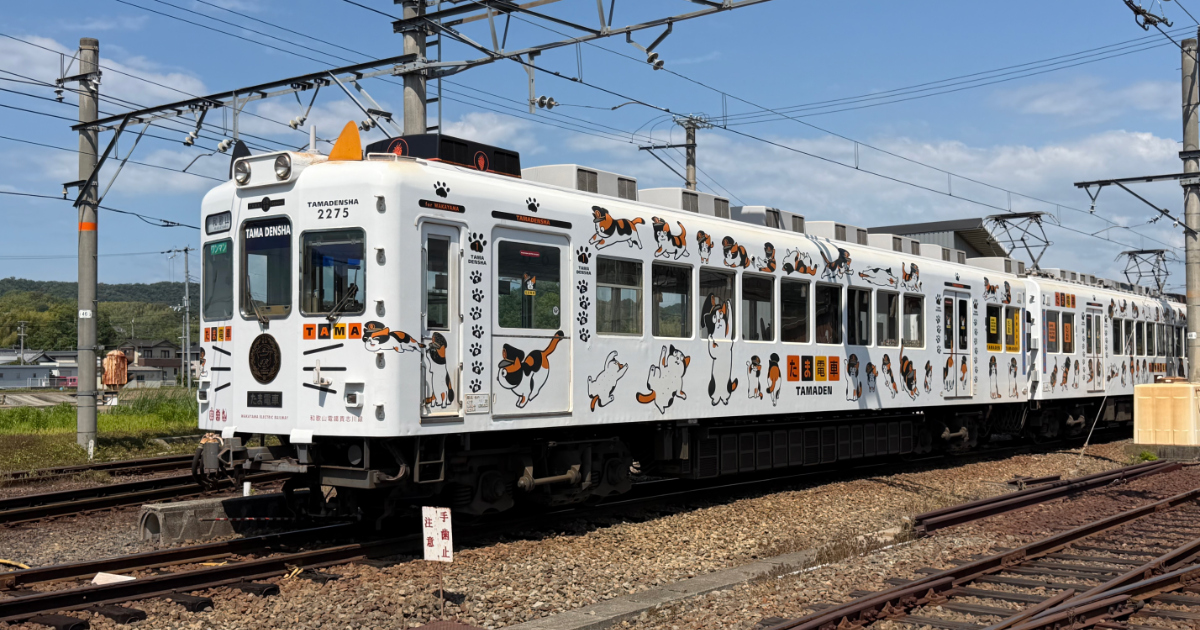
Tama would continue to rise the ranks. In 2008, Tama was promoted to “Super Station Master.” In 2009, a Tama-themed train was added to the line. In 2010, the station’s building was redesigned to resemble a cat’s face. In 2012, a calico cat named Nitama became Tama’s apprentice.
In 2016, at age 16, Tama sadly passed away. Thousands traveled to the station to mourn her passing. Tama was given the title of “Honorary Eternal Station Master.” Nitama would take over Tama’s position.
Today, Yontama, Gotama, and Rokutama are the main rotation of station masters. Rokutama is currently the youngest at just one year old. Nitama passed away last year at age 15.
Kishi Station
I started my day in Kyoto. Today is the last day in a stretch of hotel-hopping and I will be back in Tokyo at the end of the day. My first destination of the day was Kishi Station2.
I left Kyoto at about 9:45 a.m. and took the Shinkansen towards Shin-Osaka. The Shinkansen is only ten minutes. From here, I got on a non-local JR train towards Wakayama for about an hour.
Once at Wakayama Station, I was greeted by signs and posters featuring the calico cat. Following the signs and paw prints led me to the Kishigawa Line platform.
It’s important to note that the Kishigawa Line isn’t up to the modern standards that you might be used to on other lines. IC cards (including Suica) are not accepted. You must either buy a single ticket or a day pass to ride this line. For tourists, a day pass will be the best option. It’s 800 yen for an adult and 400 yen for children. For reference, paying for round trip tickets between Wakayama and Kishi Station will cost 820 yen for an adult. Plus, you get flexibility if you decide to visit any of the other stations.
The other big difference is that you must exit the train through the front of the train, where the conductors are. They will visually check that you have a valid ticket or day pass, so be sure to keep it handy and be prepared to show it.
There’s a progressive stamp rally across several stations. At the Kishigawa Line platform at Wakayama, I picked up a stamp sheet and the first stamp. I boarded the next train. Unfortunately, this was one of the trains that did not have a stamp for the stamp rally onboard, so I would need to get that later.
The entire span of the line is about 30 minutes. Despite the train only having two cars, it was surprisingly not that crowded. There were plenty of seats available and there were very few tourists. The weather perfectly complimented the lush countryside.
Once at Kishi Station, I was immediately greeted with two shrines. One was for Tama and the other was for the recently departed Nitama.
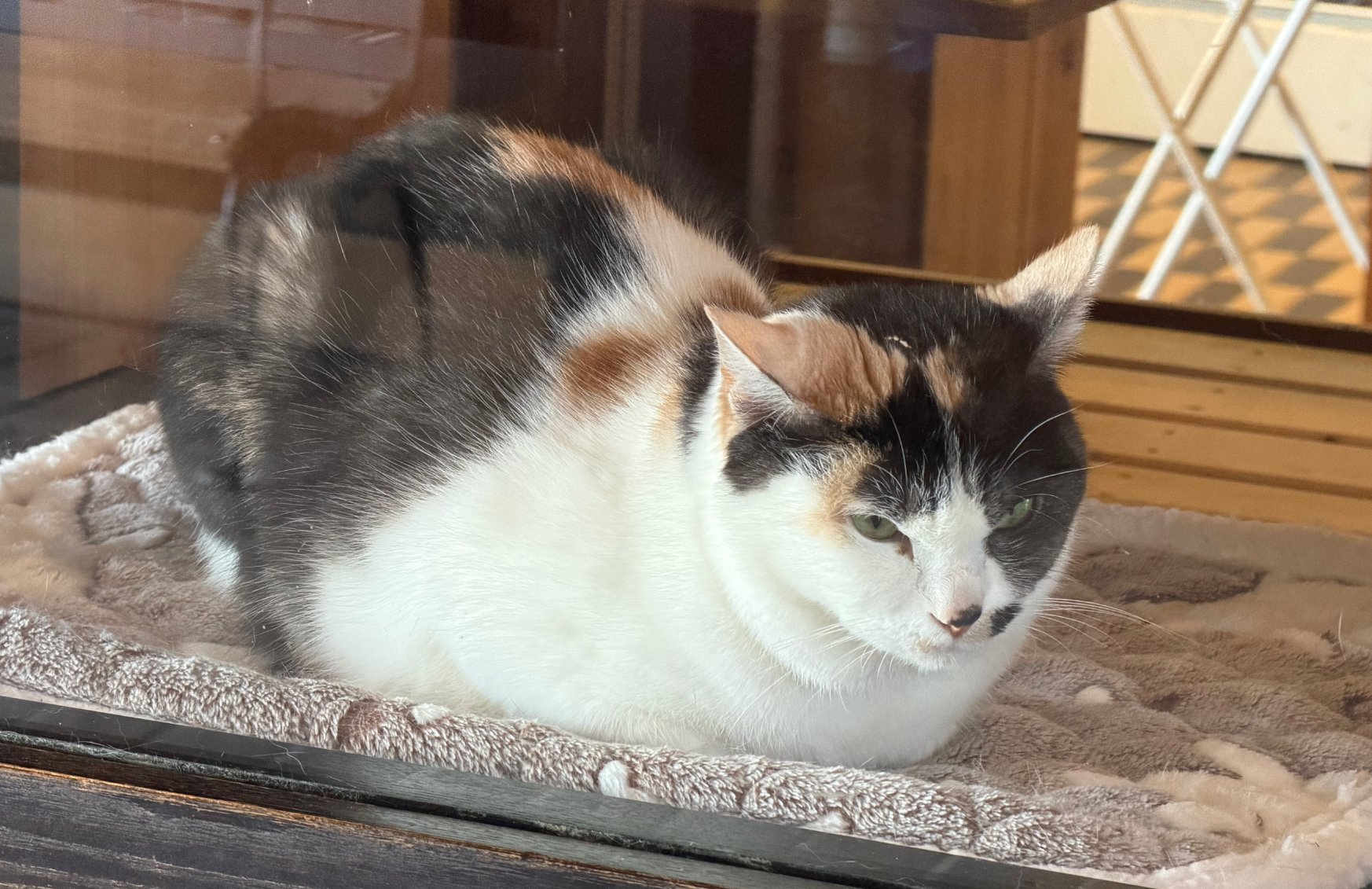
As you leave the tracks, I found the Tama Cafe to my left and the Cat Station Master Post to my right. Today, Yontama was the station master for Kishi Station. Be sure to check the online schedule for the station masters if you plan to visit.3 Yontama was mostly sleeping, but I did see her playing with shop staff during my visit. I also made progress on the stamp rally here.
I visited the gift shop to explore the Tama merchandise. There was a great variety of goods in store, from paper craft versions of their trains to ceramic Tama figurines. They even had a novelty Tama-themed goshuin (pre-printed, not handwritten).4
After shopping, I stopped by the Tama Cafe. The only real food they had was what they call a “hot cat.” It is similar to a hot dog, but with a fish sausage instead. I instead opted for shaved ice.
Across the street from Kishi Station is the Kinokawa City Tourism and International Relations Center. It’s a small building with various goods. I bought a variety pack of 羊羹 (yokan), or Japanese fruit confections.
I would have liked to explore more of the area around Kishi Station, however I had a place in mind for lunch at Idakiso Station.
Idakiso Station
I boarded the next train. This time it was a collaboration with Chuggington, a British animated children’s TV show. I would have to find another train for the stamp rally.
I arrived at Idakiso Station, which is the only other station on the line to have a cat station master. Gotama was at this station. Station staff mentioned she was a bit more shy than the other cats. There was also a smaller gift store here, with various goods.
My plan was to go to a cafe called “Cafe-A-Day,” recommended by a travel blog. However, it was closed when I arrived. Instead, I walked around the area around Itakiso Station, eventually stumbling upon a shrine called Itakiso Jinja.5
The shrine was massive and beautiful, yet completely empty when I entered. After praying, I saw the shrine office was open and received my goshuin.
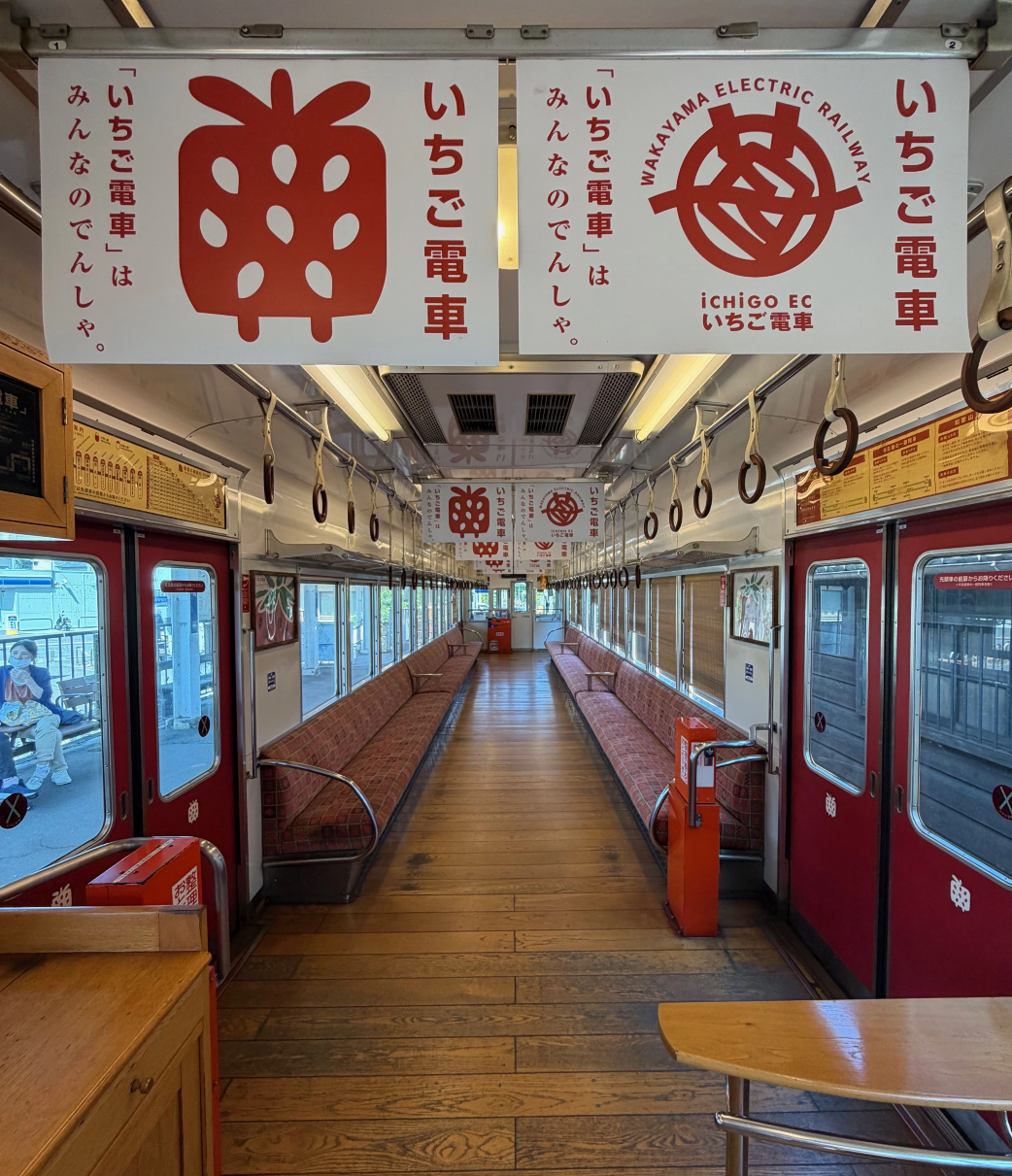
I walked back to Itakiso Station. At last, I boarded a train participating in the stamp rally. This was the famous Ichigo Densha, or Strawberry Train.
I took the train back to Wakayama Station. From here, I began my journey back to Kyoto Station.
The Return Trip
I arrived at Wakayama Station. Realizing that I hadn’t had lunch yet, I looked for something to eat. There was a 7-Eleven in the station, so I grabbed a beef and rice plate and asked the staff heat it up.
Unfortunately, the rapid train towards Osaka had departed before I could board, so I took the next non-rapid train. There were seats available so I ate my late lunch meal on the train. The non-rapid train was a bit of a blessing in disguise. I wasn’t in a major hurry and I got to pass through some familiar Osaka train stations I frequented on my trip to Osaka, like Bentencho Station.
Osaka Station is actually one of my favorite stations. Nintendo has massive advertisements on some of the platforms that are frequently changing and the station has a beautiful shopping mall above it that overlooks the city. The Tsutaya bookstore near the top floor is a delight to spend time in.
Unfortunately, I didn’t have time for that. I took a train to Shin-Osaka Station and transferred to the Shinkansen for a brief return trip to Kyoto Station.
I bought a reserved ticket on the Shinkansen, however I missed my train. Instead, I took the next train bound for Kyoto Station and sat in the non-reserved section. I briefly touch on this in my Tokyo public transit guide, but if you miss your Shinkansen, you can generally use your ticket to ride in a non-reserved car to your destination on the same day. This was my first time needing to do this, so it was good to see how seamless the experience was.
Once at Kyoto Station, I did some last minute souvenir shopping, picked up my luggage from my hotel, and boarded the two-hour Shinkansen towards Tokyo Station.